Join a global celebration of creativity in May. Sign up for Release Day!
Skip to main content

Next Vancouver speaker

Tom Froese

Vancouver Art Gallery

More info
← Load previous

Martin Jackson was born in Sheffield, England, and emigrated to Canada in 1966.

He has almost 60 years of experience as a graphic designer and calligrapher, and for over 46 years has run his own design studio in Vancouver.

As one of Canada’s foremost calligraphers he has lectured and taught across Canada, the US, Japan and Europe.

Among his many commissions are pieces for their Royal Highnesses the Prince and Princess of Wales, and for the visit of Pope John Paul II in 1984. He also produced the calligraphy for the wedding reception of Bill Gates.

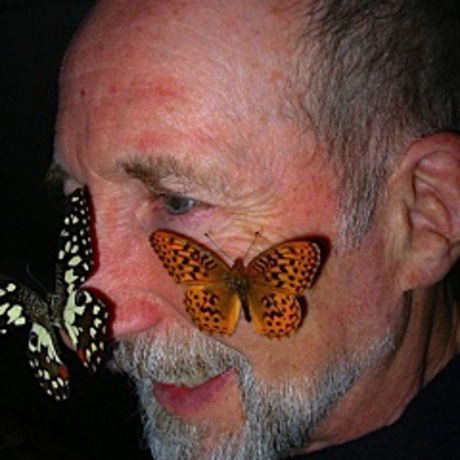
When not working on his calligraphy he is an avid nordic skier, and he collects and rears moths and butterflies.

How do you define creativity and apply it in your career?
For me it is always the challenge of meeting the clients expectations. Usually I am presented with raw text, and working with this I have to create something which must not only be legible, but also something that is visually beautiful to amaze and delight them, and also on time and on budget. I must never forget that I am just offering my services, really no different from a plumber or a carpenter etc., I can’t be too ‘Artsy’!

Where do you find your best creative inspiration?
From studying early manuscripts. There is so much to be learned from the early scribes who produced such beautiful work using the most simple tools and materials.

What’s the one creative advice or tip you wish you’d known as a young person?
Not to get too carried away with trends and fads, they soon fade, it is not good to always be ‘one of the herd’. If you have all the essential basic design skills it is better to develop your own style, it just takes time.

Who would you like to hear speak at CreativeMornings?
Crispin Elsted of Barbarian Press.

If you had a magic wand, where would you be in five years?
Alive, and still able to do calligraphy!

Why is it important we don’t lose the skill of writing things by hand?
Handwriting can be so beautiful, it is part of who we are, it can say so much about our personality.

When you check your mail box there is something very special about finding an item addressed to you that has been written by hand, it makes an immediate contact somewhere deep within us. Part of this is because you realize that the person writing to you was also thinking only of you, and will have taken more care over the choice of words, and spelling etc. I can guarantee you will open this item first. No matter what font you use for an email it will never match the magic of hand writing, and how could anyone possibly think of writing a love letter using a computer!

It is not by accident that many of the other items in your mailbox will have used fonts that look like they are handwritten, hoping you will be fooled into thinking that “dear householder’ really is meant just for you, right?

Even those who say their handwriting is awful would be surprised at how much improved their writing would be if they used a Fountain Pen. The feel of a fountain pen in your fingers and seeing the flow of the ink and hearing the sound of the nib on good paper is quite sensuous. For handwriting one of the greatest disasters of all time was the introduction of the ballpoint pen, all thanks to Laszlo Biro who invented it, ever after we were all writing in a scrawly monoline ‘style’.

How sad that so few people can find the time to ‘put pen to paper’, I don’t think there is yet an ‘app’ to solve this.

Nicole Bridger speaks on Creative Climate and Mindfulness this Friday for our February edition of Creative Mornings Vancouver. What does creative climate mean? This teaser video is a glimpse into Bridger’s creativity on demand style and how she manages stress in an awesomely authentic way. She’s got the tools to cultivate strength through mindfulness and her daily practice include meditating for 30 minutes and working through interruption. This socially conscious Vancouver clothing designer brings her honest truth to Creative Mornings this Friday, February 6th. We can’t wait to snag all her insights and kickstart the weekend with a healthy way of looking at change and relaxing one of the biggest words of our time, climate.

Pete Dupuis, from CEO and President of S&P Real Estate Corporation to entrepreneur for social change discusses World Housing on the topic of ‘Ugly.’ Inspired by TOMS shoes founder, Blake Mycoskie on a flight from Los Angeles to Vancouver in 2009, Pete spent the next three years studying social entrepreneurship, slum housing and landfill communities. In January 2013, World Housing, a housing supply program through a first world one-for-one real estate gifting model is born.

Peter Dupuis, social change visionary and the force behind World Housing fills the room at Creative Mornings speaking on the theme: Ugly.

Born and raised in Vancouver, fashion designer Nicole Bridger received her BAA in Fashion Design from Ryerson University in Toronto, Ontario. During an internship in London with Vivienne Westwood, Nicole learned the art of sculpting, draping and layering fabric. It was here that she began to realize that her talent for fashion design could also be used as a vehicle for positive social change.

In 2006, Nicole aligned herself with Chip Wilson, the owner of Lululemon. Together they founded Oqoqo, a pioneer in the North American eco-fashion market. After her experience nurturing the growth of Oqoqo, Nicole was poised to unite her passion for high fashion and eco-consciousness, and in 2008 she founded Nicole Bridger Design.

How do you define creativity and apply it in your career?
Creation

Where do you find your best creative inspiration?
Nature

What’s the one creative advice or tip you wish you’d known as a young person?
Meditate

Who would you like to hear speak at CreativeMornings?
A professional dancer.What’s the craziest thing you’ve ever done?
Started my own business.

What did you learn from your most memorable creative failure?
That failing isn’t the end, it’s a stepping stone to the success.

What’s your one guilty creative indulgence?
Buying shoes.

What fact about you would surprise people?
I had a band in high-school, I was the singer.

How does your life and career compare to what you envisioned for your future when you were a sixth grader?
I was going to be a millionaire and be done birthing children by 30, so


What keeps you awake at night?
That I’m forgetting something or not seeing a solution.

What myths about creativity would you like to set straight?
That everyone is creative not just artists.

What are you proudest of in your life?
My son.

Where was the last place you travelled?
Costa Rica

When you get stuck creatively, what is the first thing you do to get unstuck?
Go for a walk in the woods.

If you had fifteen extra minutes each day, what would you do with them?
Meditate.

Want to share your creative event with our wonderful audience?

Each month we’ll invite a couple of people up on stage and give them 30 seconds to tell everyone about something happening in our community that they should know about.

If you’re interested, email your brief pitch to vancouver@creativemornings.com. Be sure to include a slide (1024 x 768) for the big screen.

If we love your pitch, we’ll let you know and make sure you get a ticket to the event. We’ll then call you up for your 30 seconds of fame just before the talk gets started.

The deadline to submit your pitch is the day prior to the event at noon. (And It may go without saying, but please make sure you’re able to attend the event before sending your pitch.)

Thanks, and good luck!

Pete Dupuis is a serial real estate entrepreneur, lifehacker, home gifter and passionate social capitalist who believes in progress, not motion.

How do you define creativity and apply it in your career?
Creativity is the engine of positive change. I define creativity as the ability to draw from experience, knowledge and instinct to see things from a perspective that others can’t or don’t want to. My role is to apply creativity to challenge people to do things they would never have considered and encourage one to actively participate in personal growth in their profession and, if inspired, creating social change for the benefit of people in need.

Where do you find your best creative inspiration?
The ocean and mountains are a place of sanctuary and clean thinking. Being in this environment refreshes my thinking and allows me to challenge myself so i can challenge others.

What’s the one creative advice or tip you wish you’d known as a young person?
Ha, it’s a tie, so i’m giving you both: (1) take chances. Don’t be intimidated by other people that criticize and are afraid to try new things as they’re just trying to keep you at their level. (2) failure is the most important driver of personal growth. Fail often and fail well. A successful failure is just the next step to creating something of personal significance. Remember, the dude who created the sticky note failed at creating a better glue.

Who would you like to hear speak at Creative Mornings?
Scott Neeson. He gave up a his life of success and excess in Hollywood at the peak of his career to move to the Steung Meanchey dump to create Cambodia children’s fund. He’s the world leader in creating social change for those most in need. What’s the craziest thing you’ve ever done?
Travelled to, and studying, third world dump communities then locked myself in a room for 6 months and wrote my thesis. I turned my back on the first world to open my mind to what really matters in the real world.

What are you reading these days?
I read digitally. I surf zite like a vacuum sucks dirt and am actively picking away at 5 books on kindle: (1) This Will Make You Smarter: new scientific concepts to improve your thinking, edited by John Brockman; (2) HBR’s 10 must reads “On Managing Yourself”, a collection from the Harvard Business Review; (3) The War of Art: break through the blocks and win your inner creative battles, by Steven Pressfield; (5) How To Tell a Story And Other Essays by Mark Twain. Also just finished “Cycles of Lies – The fall of Lance Armstrong”, by Juliet Macur. It will be interesting to see how Lance reacts to his biggest failure over the medium term.

Not only was Opus Art Supplies kind enough to support our August talk with Kim Werker, they also sent us this really sweet letter to say thanks. We’re very proud to work with such wonderful partners!

Cree-Saulteaux performing artist, Margo Kane is the Founder and Artistic Managing Director of Full Circle: First Nations Performance. For over 40 years she has been active as a performing artist and community cultural worker.

Moonlodge, her acclaimed one-woman show, an Aboriginal Canadian classic, has toured for over 10 years nationally and internationally. The Sydney Press (AU) during The Festival of the Dreaming praised it as being “in the top echelon of solo performance.” She developed and runs the annual Talking Stick Festival and an Aboriginal Ensemble Performing Arts Program in Vancouver. Recent roles include: for TV Arctic Air and onstage For the Pleasure of Seeing Her Again opening the Magnetic North Theatre Festival at the National Arts Centre, Bah Humbug! for Vancouver Moving Theatre & SFU and Yvette Nolan’s The Unplugging for the Arts Club which won a Jesse Theatre Award for Outstanding Original Script.

She received the Inaugural Lorena Gale Woman of Distinction from UBCP – Union of BC Performers as well as a Jesse Theatre Award for Best Supporting Actress in Where the Blood Mixes, Kevin Loring’s Governor-General’s Award-winning play. Recently she was honored with the BC Touring Award of Excellence and a BC Community Achievement Award. Look forward to seeing her reprise her role in For the Pleasure of Seeing Her Again at the Talking Stick Festival 2014.

How do you define creativity and apply it in your career?
I experience creativity when I stand apart from my everyday busy work – and allow myself to drift in and out of focus, creating space for those unspoken, behind-the-scenes notions, feelings, energies to move through me, around me, rise up within me
 they begin to translate into ideas forming and un-forming around me.

I feel that space most when I am in nature, walking, musing, sitting by the lagoon or the strolling the seawall or resting with a notion or idea on a park bench. Perhaps this is the inspiration part of creativity that I am talking about


I also find that in the studio, physically warming up through movement and sound – an idea reveals itself through sound or melody, physical gestures and images begin to advance the movement through the space in ways not articulated yet, creativity in motion
 working with others in studio, creativity reveals itself in the exploration of staging ideas we have improvised together, and putting those ideas together to create a whole idea/movement/expression
Where do you find your best creative inspiration?
I don’t know if I have a best
In silence away from others, in nature, at night when the world is asleep or early in morning when no one is awake. In those ‘in-between’ moments, when the world I busy myself with, retreats from my main focus and a small opening begins to reveal images and possibilities like an intuition or waking dream that can last a few seconds, minutes or longer. From the resonance of that moment(s), my creation can begin
.What’s the one creative advice or tip you wish you’d known as a young person?
That creative ‘movement’ can save one from a world of agonies and assist one in breaking free of imagined or real restrictions one experiencesWho would you like to hear speak at CreativeMornings?
Dr. Jeannette Armstrong, Maria Campbell.What fact about you would surprise people?
I love animals – especially dogs and horses; I like to communicate with them. In fact, what people may not know is that I love to jump horses. I have been riding since I was a girl; loved the fantasy of being an Indian brave riding bareback over the prairies (I grew up in Alberta where there was plenty of room to roam and at a time when we could roam the territory, exploring paths through the bush, alongside creeks and through ravines to the river – idyllic actually).

As an adult, to communicate with a horse and develop a balanced seat and relationship with a horse is extremely satisfying. Then to actually be able to jump a course of fences and obstacles in a measured and balanced way is thrilling. The effort to maintain that balanced relationship with the horse while executing a jumping course uses many of the skills I like to develop in the rest of my life as well.

Perhaps it is a metaphor for developing and then maintaining balance in the face of uncertainty or the unknown; you practice and practice jumping different courses, different scenarios, eventually feeling you might like to test yourself and your horse in a higher stake competition when energies run high and unpredictable things may be at play.

Your horse may have an off-day or you, yourself, may be unable to stay calm enough to execute at your best or so you think. But the sheer pleasure at bringing all of those energies to the event at hand, means all of your attention is focused and ready for whatever may come – that unknown stretches in front of you
. how that translates into my performing whether it be singing or acting or dancing is fairly straight forward but how that applies to my creativity may be different again.

Because it is not necessarily that simple a process but in giving time to the development of one’s oft-times quiet inner creative intuition takes practice and willingness to dwell in the unknown and willingness to explore how to tap into one’s creativity through listening, waiting and allowing a conversation to emerge with oneself
 a little like learning to communicate with an animal such as a horse whose ways are not only different but energetically, another language
.How does your life and career compare to what you envisioned for your future when you were a sixth grader?
When I was 11 (grade 5), I formed my first company – of dancers. There were 7 of us and we called ourselves, ‘The 7-UP’ – not that inventive, I realize. But what was marvellous is that although we only sustained that company for the better part of that year, we soon advanced from performing for our mothers and fathers, aunties and uncles to performing on live TV on the Noon Show and performing at sockhops (remember them?) at school and for the community league events.

Soon I was being ‘head-hunted’ to producing events like the Teen Dance at the community centre and into teaching creative dance to children. My life evolved from dreaming of being a jockey (a career my father tried to steer me away from), commercial art (which my Dad thought might be a career for his horse-drawing daughter) to dancing and performing and being part of creative development with others in the performing arts field.

more