
Just because you can’t see it doesn’t mean it doesn’t exist.
There is so much invisible information out there in the world, and we never slow down and gather up more than what is easily presented and consumable. We can only see what our senses can afford us! In this December gathering for the worldwide theme of “INVISIBLE,” Garth Spellman, Associate Curator of Ornithology, shares how birds, and much of nature, communicate through the exchange of information on frequency levels we just simply don’t have the senses for as humans. Whether it’s infrared or infrasound, the way the world looks is a matter of perception, and when it really comes down to it, what we think and how we see the world is just a sliver of reality.
About the speaker
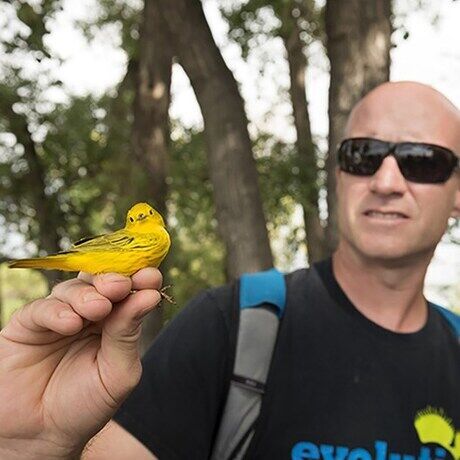
Dr. Garth Spellman is curator of ornithology at the Museum. He grew up in Fargo, North Dakota, and developed a passion for biodiversity science through his first summer job as a lab assistant pinning beetle specimens in a paleontology lab at North Dakota State University. Garth went on to receive a BA in biology from Carleton College, an MSc in zoology from the University of Alaska Fairbanks, and a PhD in biological sciences from the University of Nevada, Las Vegas. He began his professional scientific career at Black Hills State University, initially as a research professor and eventually moving on to become an associate professor. Garth then spent two years serving as a program director in the evolutionary processes cluster of the Division of Environmental Biology at the National Science Foundation. His peer-reviewed manuscripts have been featured in diverse scientific journals, and his work has been featured in several popular press articles and blogs. His research focuses on how recent and ancient environmental changes have affected bird species. Bird species are products of their environment and therefore are constantly evolving in response to environmental change. The response of a species to environmental change leaves lasting footprints in its DNA. Garth uses genetic tools to examine “bird DNA footprints” and determine just how a species or multiple species that make up a modern community have responded to past environmental change.
Favorite quotes from this talk
Photos from this talk See all

Hosted by
Denver Museum of Nature and Science
2001 Colorado Blvd.
Denver, Colorado United States 80205
Date