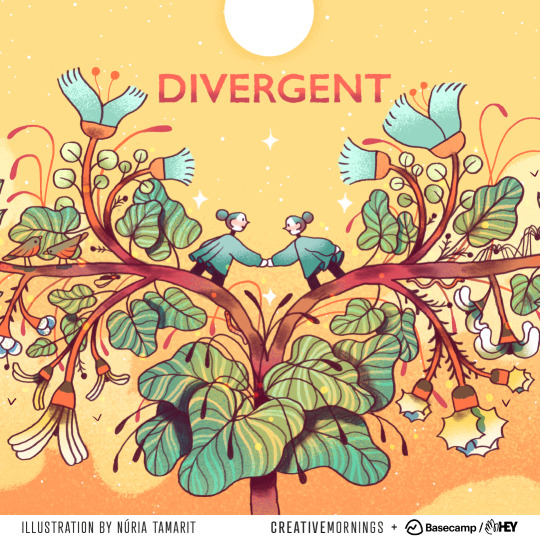
Welcome to February and #CMDIVERGENT
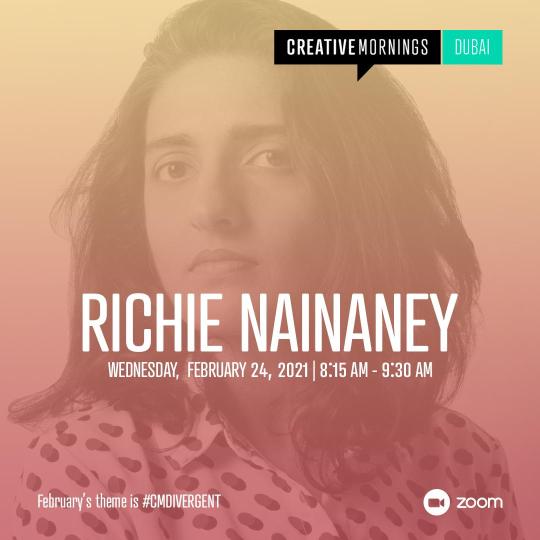
Richie Nainaney is our speaker this month.
https://creativemornings.com/talks/richie-nainaney
We are creatures of ideas.
by Randah Taher
We pride ourselves with knowing how to think differently and how to solve problems in different directions.** **
By our very nature, we are divergent.
Like many of you, I’m a highly kinetic learning.
We seek constant stimuli. We get our knowledge from things we see, hear, touch, feel, taste, or experience. We’re constantly bringing in information for our brain neurons to sort out, decide what to keep in our short-term memory and what to archive. For some, this is a thriving environment and cities cannot have enough of them. For others, it becomes overwhelming at best.
This is the first part of embracing being “divergent”. In your world, how many sources bring in the knowledge you seek and the experiences you enjoy every day?
The second part of being divergent is on the other side of thinking, when you’re ready to provide a solution to one of those problems you face.
When in that thought process, we generate ideas that go well beyond the scope at hand. We associate ideas with other topics. We create analogies. We power up our imagination. We basically generate creative ideas by exploring many possible solutions. This mode typically occurs in a spontaneous “non-linear” manner that makes it possible to have many possible solutions in a short amount of time.
If we pay close attention, we get to hold still a bit longer than the “regular” non-divergent people. We don’t stop at the first good-enough idea. We continue until our brain is forced to build on previously half-cooked ideas and we finally see the unseen.
Research in the creativity field did not let this magic trick go unnoticed and wanted to test it. The most widely administered test of divergent thinking and other problem-solving skills is the Torrance Tests of Creative Thinking developed by E. Paul Torrance in the late 1950s. The Torrance test includes both verbal and figural tests that require people to generate multiple possibilities (“How many uses are there for bubble gum?”), and imagine the consequences of unimaginable events happening (“What would happen if people could become invisible at will?”).
Originally designed to score on four scales. These are:
· Fluency. The total number of interpretable, meaningful, and relevant ideas generated in response to the stimulus.
· Flexibility. The number of different categories of relevant responses.
· Originality. The statistical rarity of the responses.
· Elaboration. The amount of detail in the responses.
I’m curious, how do you think you will score on all four?