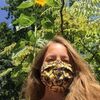
 Andrea Chlebak is the Senior Digital Intermediate (DI) Colourist and Director of Creative Services at Central, a boutique post-production facility in Vancouver.
Even as a young child in Winnipeg, Canada, Andrea was inclined to view the world as a series of moving pictures. In fact, her earliest paintings feature the family’s kitchen curtains billowing in the breeze. She fell in love with photography as a teenager, but a continued fascination with movement ultimately led her to film.
A fortuitous encounter with film as an art student first opened Andrea’s eyes to the possibility of a career as a colourist, but several years would pass before she took her seat in the colour suite.
After graduating from the Emily Carr Institute of Art & Design in 2002, Andrea honed her skills in on-set photography, and picture editing before joining Central in 2004. When the company opened the city’s first DI colour grading studio, she seized the opportunity to become a colourist’s assistant.
Within six months, Andrea had earned the main DI colourist credit on her first feature film. Since then, she has cast her keen eye over a rapidly growing library of television series and films, including Hollywood heavy hitters like Elysium and The Twilight Saga: Eclipse and award-winning documentaries like Facing Ali and Saving Luna.
Having studied art and film and spent years behind the lens as a photographer, Andrea brings an artistic sensibility and technical rigour to her projects. Her flexible approach and infectious personality have resulted in rewarding collaborations with respected directors, cinematographers and VFX supervisors.
Outside the colour suite, Andrea finds inspiration all around her, from the chestnut tone of her morning espresso to the rich emerald forests and cool grey waters of the Pacific Northwest.
How do you define creativity and apply it in your career?
I used to think of creativity as being synonymous with productivity, but lately I’ve been thinking about it more simply as the process of making connections. I visualize this as looking through a viewfinder to photograph a scene. The image you produce is simply the result of the connection process. Seeing the scene in real life, looking through multiple lenses and angles, and then choosing a combination of angle, lens, and exposure is the result of you being able to see the same thing in different ways and connect a few ideas.
When I work on a film I learn as much as I can about the director’s main influences and then I collect inspiration from a variety of sources to inspire the colour treatment for that film. Forming the vision is in many ways more creative than the actual production aspect of what I do.
Where do you find your best creative inspiration?
People and places. Most of my collaborators (directors, cinematographers) have fought hard to get to where they are and are extremely passionate about what they do, meaning they all have good stories. Spending time getting to know them, learning about how their experiences and motivation, really inspires me and influences how I work.
I also feel that travel brings necessary insight, so I try to plan in a small break at some point during a big project. I find that getting away from the work, enjoying life and seeing a different part of the world really helps invigorate my process. Most often I return to my work and something has changed in how I see it.
What’s the one creative advice or tip you wish you’d known as a young person?
Share your work and ask for criticism, but don’t attend every review of your work. Let people meet about that scene, layout, website navigation etc on their own — force them to summarize their reactions and [attempt to] give coherent notes. Remove yourself from the discussion, especially with a group of producing types.
By doing this you spare yourself irrelevant notes and comments motivated by fear or lack of knowledge (e.g. “Can you make that text bigger?” “Can you centre the photo so people definitely see it?” ” Can you make everything brighter and less interesting because I am worried that the person with the old television, who has the colour settings set to ‘Sport Mode’, won’t see every detail in that shot?”).
If you show up to a review like that you are saying, “Please! please give me all of your notes and then integrate everything you say.” The outcome is rarely positive; either you get stuck defending your work, embarrassed to be on the project, or you become a production artist enabling the “design by committee” process.
Who would you like to hear speak at CreativeMornings?
Terri Tatchell, Pete McCormack, Evan Goldberg
What fact about you would surprise people?
I am a would-be 8th generation baker. My parents actually owned and operated a bakery from when I was about 4, so you could say that I grew up in a bakery. The experience is so much a part of my personal make-up, I can’t help but reference baking as a metaphor for what I do… I also make a mean artisan sourdough.
How does your life and career compare to what you envisioned for your future when you were a sixth grader?
In the sixth grade I was obsessed with Disney (The Little Mermaid, Aladdin and The Lion King especially) and I loved to draw. I asked for a framed cell painting from The Lion King one Christmas and I dreamed that I would be an animator when I grew up.
Funny enough, I just finished grading an animated film with Roger Allers, the director of The Lion King. So you could say that I wasn’t far off in my vision. He even drew me an original Simba for my wall since I never got the cell painting.