Speaker Spotlight – John Vigeland
Co-Founder/CFO, East Fork
Website | Instagram | Facebook
Theme: Symmetry | February 2019
Tell us a little bit about yourself and your practice.
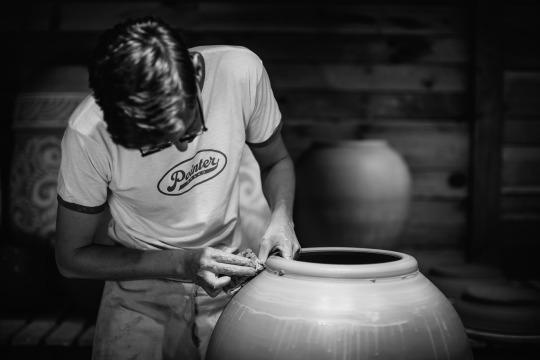
Well I started down this path by studying the traditional pottery of the southeastern US during a 3 year apprenticeship with a potter down in the piedmont. That looked sorta how you might imagine: preparing clay, cleaning buckets, maintaining the kiln, cutting firewood, and learning how to throw pots in relation to a particular traditional lineage, and a lot of earnest striving.
Now my day-to-day looks quite different: I create and maintain financial models that allocate and track the flow of resources through our small company which involves a good bit of computer time. I work with different department heads to troubleshoot operational problems like inventory management, budgeting, production planning, marketing spending and analysis. And spend a lot of my mental real-estate on worrying about the best, safest, bravest, truest path forward for East Fork.
What did you want to be when you grew up?
I remember having artistic aspirations as a young child–nothing specific, but I imagined I would grow up to do something “unconventional.” A flower farmer in the south of France who writes killer haiku, an abstract expressionist, a hunter-gatherer, etc.
Can you remember when you first learned about your field of work? How did you discover what it was, and how did you know it was what you wanted to do?
A career potter came and presented to my ceramics class my senior year of college. Hearing her talk, it was the first time I put it together that being a potter for a living was even an option. I was really in the thrall of making pottery on the wheel at the time, and the idea that I could do that professionally was intoxicating. It aligned with my sense that I wanted to do something a bit outside of the fold to earn my keep (see above).
What is the best part and hardest part of your job?
The answer to both of these questions is the same I suppose: the unrelenting call to step into difficult situations and be vulnerable; to be asked to try your best and know that you’ll fail sometimes. On the other hand, it’s a privilege to get to bear witness to the people around me stepping up to things, misstepping and succeeding, growing and changing. Opportunities for growth–they’re so hard but totally what it’s all about.
What on-the-job tools do you use every day?
O man–it’s cheesy as hell but the first thing that springs to mind is compassion. Being able to coordinate a group’s efforts efficiently toward a shared goal and to problem solve along the way requires that we all continually try to understand each other’s thoughts and feelings and perspectives.
What about your community inspires you?
Getting to see a group of people looking out for and taking care of each other is always inspiring. Also doesn’t hurt that everyone here is smart and funny and talented and delightful in a thousand different ways.

What is the best piece of business advice you’ve been given?
Just because it’s the status quo, doesn’t mean you have to do it that way. It takes more effort, but scrutinizing why certain structures or policies or systems are “standard operating procedure” for businesses is the only way you can own the process, and create something that is authentically a reflection of your values.
If you were magically given three more hours per day, what would you do with them?
I imagine that during these 3 hours I’m also a more virtuous, strong-willed individual than my current self–so in this fantasy I would go out for long pleasant runs where I reflect meaningfully on the day and poetically observe the cedar waxwings eating the dried-up crab apples in the neighbor’s tree. 3 hours of peaceful contentment if possible.