
Stop shopping. Start sewing.
About the speaker
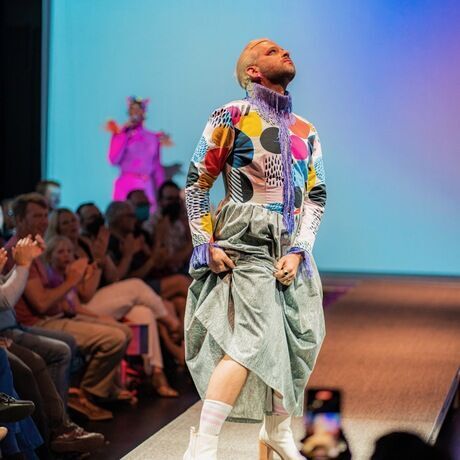
Steven Frost’s practice begins with textiles and the belief that cloth can hold memory, labor, and identity. They were first drawn to fiber as a space on the margins of the art world, paralleling their own experience of coming out as queer. Weaving allows Steven to embed meaning directly into fabric, where every thread, fiber, or upcycled scrap carries its own history and becomes part of the work.
Their practice combines traditional techniques with nontraditional and repurposed materials to create textiles that reflect both personal and collective histories. By working with what is discarded or overlooked, Steven invites viewers to find recognition in familiar textures, sparking conversations about value, care, and repair.
Collaboration and pedagogy are central to their approach. Steven views weaving as a metaphor for community and often creates opportunities for people to make together through workshops, residencies, and public projects. These spaces of shared labor invite dialogue and help participants imagine new ways of belonging. Their work frequently emerges in partnership with others, whether through collective weaving, mentorship with queer youth, or collaborations across disciplines. At its core, Steven’s practice explores how textiles can convey meaning and how collaborative making can foster connection.
Favorite quotes from this talk
Photos from this talk See all

Hosted by
Junkyard Social Club
2525 Frontier Ave Unit A
Boulder, CO United States 80301
Date
Partners
Junkyard Social Club
Ad Club Colorado
City of Boulder Office of Arts Culture
Peak State Coffee
The Brand Studios
Organizer social media Myriam Benoit
Volunteer Kira Warren
Organizer social media Danielle Hartig














“Weaving is a metaphor for community—every thread matters, and together they create something stronger, more beautiful, and more meaningful than any strand alone.”
“Textiles are a way of holding onto something—memories, identity, community. They wrap our bodies, but they also wrap our stories.”
“I realized that the car wrap wasn’t just about visibility—it was about honoring a love that had been hidden in plain sight.”