Reflections on Art and Education: Shaping Social Change” with Jacqueline de Montaigne and Marcela Nacif
On a beautiful September morning, CreativeMornings Lisbon drew an impressive crowd to the stunning Jardim das Oliveiras at the Centre Cultural de Belem. Making the most of the
Portuguese autumn sun, guests mingled in the garden set against the backdrop of the Tagus River and iconic Ponte 25 de Abril, one of the city’s most recognisable landmarks.

A Saturday morning edition didn’t deter the creatives who turned out for one of our biggest meetings, with delicious empanadas served alongside energy drinks by @SAVG and coffee by Lavazza to keep those attending nourished and refreshed before our talk began.
As the presentation opened, we learned this month’s global theme, chosen by the Oklahoma chapter of CreativeMornings: Reflection.

The speakers in Lisbon would share their unique reflections on art, education and social change. The first speaker, Marcela of Brave Generation Academy, took us on a journey through her
vision for education. She believes a change is necessary and that initiatives, creative thinking and technology are the way to deconstruct our concept of what “education” means.

Four years ago, Brave Generation Academy – an NGO set up to make education more effective and successful - created a hub, led by people who believed education needs to change. Instead of having a building with classrooms, they realised (thanks to technology),
you could spread classrooms around the world. Instead of having just one teacher, it might be more helpful to have two: one who looks after the academic curriculum, while the other motivates the best version of the student to emerge. Brave Generation Academy created hubs around the world, with thousands of students in 9
different countries. Learners study online, through a synchronous programme. Brave Generation Academy allows education to be more effective and accessible to learners, and empowers learners who couldn’t access education before, to see it’s not that
hard to make education accessible. “We realised we can democratise education. If you have internet access and the will to
learn, you can.”

The idea, Marcela explained, was to not make profit, but to convert cashflow into scholarships so anyone who wanted to go could attend. And so, over 300 entry scholarships
were created, alongside non-profit initiatives including a not-for-profit hub. The ethos of BGA centers the students. Their projects include a hub in a refugee camp in Kenya, a program for students from Gaza, and a refugee camp in Congo. For those who are fleeing
war and trauma, underfunded education systems that offer little prospects are not uncommon. By teaching refugees digital skills, in a hub that fosters a sense of community while following an internationally recognised curriculum, Brave Generation Academy helps to empower learners to build their own path: taking control of the learning process at their own pace. Marcela then posed an important question: Without educated young people, who will
rebuild countries that have been torn apart by war? Without them, perhaps no one. “It’s not that hard to change education, we just have to change our mindset.”

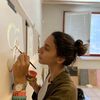
Next, we heard from the artist and activist Jacqueline de Montaigne, who has painted murals around the world: many of which are used in social initiatives. Jacqueline uses guilding in a public way - with a minimal amount of paint, reducing the eco footprint – to
tell stories through symbolism. Her art brings natural and figurative elements to an urban context, to create a fascinating juxtaposition of (what we might think of as) opposing forces.
Although she grew up in a household of activists, her journey as one began upon the birth of her second son. There was no one in the hospital that could help to provide guidelines or evidence-based information about baby feeding. Through this experience Jacqueline became involved with social change at a policy level, to help change national guidelines and train national forces in how to feed minors in the event of a national emergency. Her activism focused upon the correct marketing and labelling of baby formula products, while
her artistry has seen her paint murals to raise awareness about breastfeeding.

Jacqueline has also painted refugee camps with educational murals, which break through language barriers. Her work with murals began when she painted a small one at Lisbon’s Lx Factory, and she discovered she was hooked. She decided to use this medium as a platform for social good, to bring awareness to issues using non-invasive paste-ups that can be removed by sponging off afterwards.
She was the first Portuguese woman to be ranked globally for her mural painting. However, during her presentation Jacqueline also brought our attention to the challenges faced by women who want to become full-time artists: less than 3% of artists can afford to live off
their work, and in the global market, less than 2% of work is allocated to women. But she left us on a hopeful note, as her work has led her around the world, having special interactions with normal people who have become the muses of her murals. “Regardless of age, there’s nothing to stop you following your dreams. The impact we can have on other people’s lives is massive.” And with that, our CreativeMornings guests returned to the sunny Lisbon afternoon a little lighter.

Text: Niamh Hynes Photos: Desiree Kong