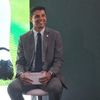
Nur M'nasria is the DARE speaker at CreativeMornings in Dubai!
All
Talks
Individuals
Chapters

Nur M'nasria is the DARE speaker at CreativeMornings in Dubai!


— michael r. ogden
teacher, scholar, storyteller
Dare – verb, uk /daer/ us /der/
to be brave enough to do something difficult or dangerous, or to be rude or silly enough to do something that you have no right to do.
Cambridge Dictionary (online)
As an academic, words matter. I imagine the same is the case for most people. Reflecting upon this month’s Creative Mornings theme of “dare” I find the word to be powerful, challenging, and enabling. But it can also be the gateway to foolishness—which, in a way, is also powerful, challenging and enabling! Let me explain.
As a young, impetuous child growing up on a farm, my siblings and I would frequently dare each other to do things we normally would not have done. Most of these were innocuous, “I dare you to climb to the top of the cherry tree,” hardly even a challenge! One day the dare was to ride on the back of our smallest and friendliest steer, “Curly” … it didn’t work out as I planned. Curly walked out of the barn a bit perplexed, I imagine, having me on his back and he was not having any of it! I met a quick and ignoble end having been bucked-off of Curly’s back and into a large compost heap of manure (much to the amusement of my siblings!). Sometimes, a dare prods us into playing the fool. I survived the dare (with a bruised ego and bum), so what did I learn by daring to taking up the challenge … and failing? Like so many dares we face in life, I learned to think twice before accepting the next challenge! But this is the safe choice, and as the late Harry J. Gray, American business manager, philanthropist, and former CEO and chairman of United Technologies once said, “no one ever achieves greatness by playing it safe.”
Of course, most childhood dares are for the entertainment of the person(s) issuing the dare. They are not intended to be life-threatening, but humorous, and certainly embarrassing! But what if you are the one who issues the dare? And, what if that dare is to yourself? These tend to be the hardest dares of all and frequently cause us the think twice; disempowering our abilities, foreclosing our choices, and denying us a chance to write ourselves anew. Being impetuous and foolish comes with youth, but as we mature into adults, we fear being labelled “the fool” and frequently don’t take up the dare—especially self-imposed challenges that take us well beyond our comfort zone. But, when you dare yourself to take on the challenges that stretch you when you’re brave enough to give yourself permission to “play the fool,” you empower yourself to take an active role in shaping your life. As you make the conscious effort to dare yourself by setting “impossible” goals—and achieve them or fail in the trying (but learn to keep trying!)—you are going to have a richer life experience. As Linda El Awar, a freelance management consultant, stated, “The cost of playing it safe … could far exceed the cost of daring to change.”
In the years since my life on the family farm, I often shirked off the dares of others but I have always taken on the dares I issue to myself. Sure, sometimes I played the fool, and probably still will, but even these occasions have led me to new and interesting learning experiences that have made my life the wonderful story it is today … and that story is still being written!


By Nada Badran
When I first started reading about matriarchy, this June’s theme, and tried to imagine a society where women make all the key decisions that shape the safety, health, education and culture of the community, I came across a few headlines describing the ‘last matriarchy in Europe’, the isolated Estonian island of Kihnu.
Digging deeper, I discovered the stories of women whose roles expanded beyond the traditional norms and are described as the official custodians of life on the small island. The women of Kihnu balance the responsibilities of farming, husbandry, child-rearing and daily life –all powered by their strength and steadfast resilience. These women could (and can) do it all, without making the decision that something had to give. While the headlines suggest the end of such societies, I would argue that such women exist all over the world.
Women who have put in enormous hard work and commitment and are making massive strides in redefining norms as they go along. Addressing their achievements is an occasion to celebrate their progress, but also to critically reflect and strive for greater momentum worldwide.
In politics, we’ve seen how female leadership has helped manage the COVID crisis at a time while walking on a tightrope between balancing the health of people with that of economies. New Zealand’s PM Jacinda Ardern’s politics of kindness and compassion has received world praise. In health, women make up a majority of front-line workers as health care workers and caregivers (Source: UN) and in the home. Without their unwavering support and care, the lives of all of us and our families would be at stake, as the pandemic has highlighted over and over again.
In education, where teaching is an overwhelmingly female profession, faculty are tasked with grooming the minds of future generations to become leaders, a responsibility that many are entrusted with and successfully deliver. Again, the pandemic has highlighted the incredible importance of their contributions particularly when teaching has moved online, on an untested and unprecedented scale. In science and business, women have made substantial contributions to the world economy and knowledge bank we so heavily rely on, yet still, experience a gender gap in their recognition for it and missing rungs on the leadership ladder.
There are many great women leaders across various industries and realms, ones with megaphones and ones working behind the scenes, who will continue to strive to create a better world. I encourage you, the reader, to hear and share their stories and triumphs. Because without them, where would our world be?


[Resiliencegenerally means the ability to recover from some shock or disturbance.]
By Munem Qureshi
Resilience is one of the basic building blocks of human nature. We have all gone through things in difficult times that have made our power of resilience stronger. In life nothing will go to plan as you intended it and you might have to face setbacks or sometimes you might have to abort the mission for a while, but resilience will guide you.
Let me explain what I mean from my own experience.
Covid 19 has changed the whole ecosystem around us. For a year CreativeMornings has been happening, virtually, and it is still virtual. This is an example of how resilience works. Even though we had a setback and were unable to perform a task as planned, have in-person events, we found a way to keep moving.
This year I have learned that it is important to plan things as you really want them to happen and if you fail to realise the ideal just keep looking you will find an answer as to how to move on.
Resilience, to me, is all about accepting change and learning to survive.
Another example of resilience that I would love to share is the loss of a loved one. I was quite young when my grandmother died, she meant the world to me as a child. I saw my grandmother as my role model and after her death, for some time, I was shattered. But eventually, I came around and resilience kicked in. What kept me going were my grandmother’s teachings. My grandmother taught me many lessons, to be kind, to help others who you can and to make sure you put the biggest smile on your face even when you are going through rough times.
What I have learned over and over in my life is that resilience is power, maybe our superpower, that allows us to keep things alive and allows us to bounce back from all the setbacks we face.
Time doesn’t stop for anyone, and it is through embracing resilience that we prepare ourselves to meet anything that is thrown at us.


by Kat Fernandes-Kinsella
Don’t read this.
Go do something useful. Or something un-useful.
There are eleventy-billion more interesting, addictive, time-killing things to do than to read this. Untold earth-shattering riddles to solve. Has Lubalin dropped a new drama?* What if we lost gravity for 5 seconds? Can you explode bad kitties with word scrambles? And what is that cloud formation?
You’re still here.
We have important things we should be doing right now. We have interesting, significant things we could be doing right now. We have banal things we’d love to be doing right now. We could be learning this. And we have multi-billion dollar industries that are desperate for our attention, money, addiction and information which make things appalling.
Yet here you are.
And here I am.
A life-long, chronic procrastinator who has struggled against dallying while reveling in dallying. However, I have found ways of working effectively despite myself and collaborated with non-procrastinators without them killing me.
The pro-active, time-royalty have probably stopped reading by now. But perhaps my kindred-spirits-in-putting-things-off may still be here, in which case let me share some experiences in making tiny changes which gently alter my intention and journey.
Perhaps you can make gentle changes too.
Yes, we can change and there are many wonderful, practical tools, techniques and strategies which can reshape our day and our impact.
Foremost for me, though, is a daily practice of intentional pausing, breathing and reflecting.
Pause. Breathe. Reflect. It may take a few minutes or longer.
Pause. Breathe. Reflect. It could just be a beat.
Pause. Breathe. Reflect. It might open the gap between stimulus and response.
Pause. Breathe. Reflect. A chance to recognize some truths, however ugly.
Pause. Breathe. Reflect. Want to hear some?
The Ugly Truth I: I have natural intelligence, a hint of charm and a history of very manageable challenges, flexible deadlines and mundane consequences. This is preprogramming for sloth (and the fear sloth induces).
The Ugly Truth II: I don’t like feeling uncomfortable and starting something I don’t like or something unmanageable feels awful (until the hyper-focus comes). This makes idle ideal (and the fear idleness generates).
The Ugly Truth III: I am a sucker for distracti…oooh! Camel! I click the bait and gleefully dive headfirst down rabbit holes. This creates excuses (and the fear of getting caught in an excuse).
The Ugly Truth IV: The further away the reward or punishment, the greater the apathy. Why start now? In fact, why start? This creates the fear of never getting started, never knowing if I would have made it, and the fear of the fear.
The Ugly (But Really Wonderful) Truth V: I am not alone. I know some of my brethren are nodding their heads now). I am not so unique after all. This creates… possibilities.
Pause. Breathe. Reflect. Maybe there are greater truths underlying these.
Pause. Breathe. Reflect. Last month, a storyteller wrote of kindness and compassion.
Pause. Breathe. Reflect. Starting with kindness, curiosity and compassion to ourselves is a wonderful idea.
Pause. Breathe. Reflect. And perhaps there are more gentle approaches to be explored… when I get round to it.
* At time of press, Lubalin has dropped nothing new. But still I wait.


— michael r. ogden
teacher, scholar, storyteller
When contemplating this month’s Creative Mornings theme, “Ripple,” my mind wandered… I recalled a Grateful Dead song of the same name on their 1970s album, “American Beauty,” that expressed the joys of music and how we must all choose our own path. I thought of my childhood growing up on a farm watching fish rise to sip bugs off the still surface of our pond causing concentric “capillary waves” (i.e., ripples) from the fish’s action (and the bug’s demise) that eventually reached the edge of the pond only to gently rebound back and slowly dissipate from view (still continuing, only at the invisible “nano-level”). The “science-geek” in me also thought about gravitational waves rippling through the universe as massive black holes merge, barely detectable by our present scientific instruments, yet they continue for infinity in the fabric of space-time. I then remembered one of my favorite ice cream flavors, “huckleberry ripple.” That made me hungry, so I got a snack!
In the realm of Psychology, there is the concept of “the ripple effect.” Irvin David Yalom, an American existential psychiatrist and emeritus professor of psychiatry at Stanford University, introduced the phrase in his book, Staring at the Sun: Overcoming the Fear of Death (2008). I’m not here to talk about death (although, one could venture the belief in reincarnation to be a ripple of one’s consciousness through time, I suppose). No, it is Yalom’s explanation of the “ripple effect” that most interests me. He writes that the phrase, “…refers to the fact that each of us creates—often without our conscious intent or knowledge—concentric circles of influence that may affect others for years, even generations. That is, the effect we have on other people is in turn passed on to others, much as the ripples in a pond go on and on until they’re no longer visible but continuing at a nano level” (now you know where idea in the first paragraph came from!).
2020, for most of us, is a year we’d like to forget, strike it from global memory, fingers in our ears, “la, la, la, la… go away 2020, I can’t hear you!” But, there is no denying that COVID-19 caused global ripples through our health care systems, our economies, our communities, our families, and our psyche that are still rebounding today and will likely continue at the “nano-level” for a generation, maybe longer. The “ripple effect” from the pandemic brought fear, frustration, and anger as well as denial. People grew suspicious, rude, and aggressive. They took to social media to vent with globally devastating effects as concentric waves rippled from our “doom-scrolling,” potentially impacting us and others in ways we may never know, rebounding until only the nano ripples remain… unseen but felt.
But, what if the “ripple effect” was one of compassion and kindness. Instead of spreading emotions such as fear and anger, this “ripple effect” spread emotions such as love and caring. I’ve noticed it myself when watching a video showing a kindly act and just how hopeful it makes me feel, restoring my faith in humanity, and brightening my day… Kindness and compassion are never wasted, absolutely never. Like huckleberry ripple ice cream on a warm day.


https://creativemornings.com/talks/abdullatif-alsayegh