About the speaker
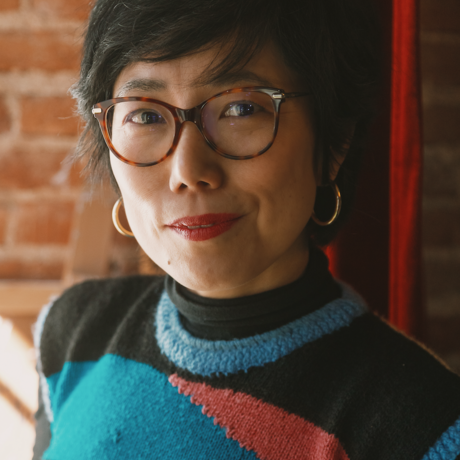
Se Jong Cho practices and teaches art in Baltimore. As a research scientist, she studies landscapes and rivers, and develops data- and physic-based models.
When Se Jong immigrated to the United States as a teenager, she gave up painting and a career in the arts with a belief that the “American Dream” would be more attainable through the STEM education. She changed her major from Fine Art to Civil Engineering and went on to complete her undergraduate degree at Northwestern University (BS. 2003), and two masters degrees (MS. 2009 and MSE. 2014) in Environmental Sciences and Engineering at Johns Hopkins University. But she felt like an imposter throughout her academic career with doubts about her aptitude in science. She started painting again while pursuing a doctorate in Environmental Engineering and Policy Analysis at Johns Hopkins University (Phd. 2017). The act of painting guided her toward the completion of her STEM education. She discovered that painting taught her to recognize the incremental nature of progress and cultivated faith in her creative capacity.
In the beginning, her pursuits in science and art were in parallel lines, separate and independent. Now, after painting for a decade, the parallel lines of science and art began to converge. The training as a scientist taught her to become observant and think critically, and painting renewed her sense of curiosity. She cultivated a brand of imagination through the studies in science, and developed painting techniques informed by engineering discipline. Her scientific research is also branching out to integrate art with environmental issues because as Primo Levy puts it, “official science often lacks humility.” While science and engineering can provide data and tools for addressing environmental issues, it is often not sufficient to guide humanity toward a sustainable future. Se Jong believes that art touches people where science can't reach. In the convergence of science and art, complex stories about human relations with the natural world can provide a context for humanity’s present conditions and dreams for the future. Therefore, she is steering her practice to integrate multi-disciplinary perspectives to produce new artistic experiences as a way to engage the audience, rather than didactic approach to addressing environmental issues.
Photo by Schaun Champion
Favorite quotes from this talk
Photos from this talk See all